AI in Your Pocket
AI is no longer confined to data centers — it’s now running directly on your devices. This blog explores the rise of on-device AI and TinyML, technologies that enable smartphones, wearables, and even microcontrollers to run intelligent models locally. With companies like Apple and Google integrating AI into chips like the Neural Engine and Tensor, we’re seeing faster, more private, and more efficient machine learning experiences. From offline voice assistants to smarter photo tools, on-device AI is redefining how and where we use artificial intelligence — making it faster, safer, and more personal than ever before.


Not long ago, AI meant the cloud. Today, it lives in your phone. Quietly. Locally. And it’s just getting started.
A couple of years back, using AI meant hitting a remote server, waiting a few seconds, and hoping your data was secure in some giant data center. But now, we’ve reached a point where your phone — without internet — can run intelligent models that feel almost magical.
This is what we’re calling on-device AI, and when it runs on ultra-low power chips or microcontrollers, it’s often grouped under TinyML.
What’s wild is, this isn’t some lab experiment. You’re already using it.
From Cloud-First to Local-First
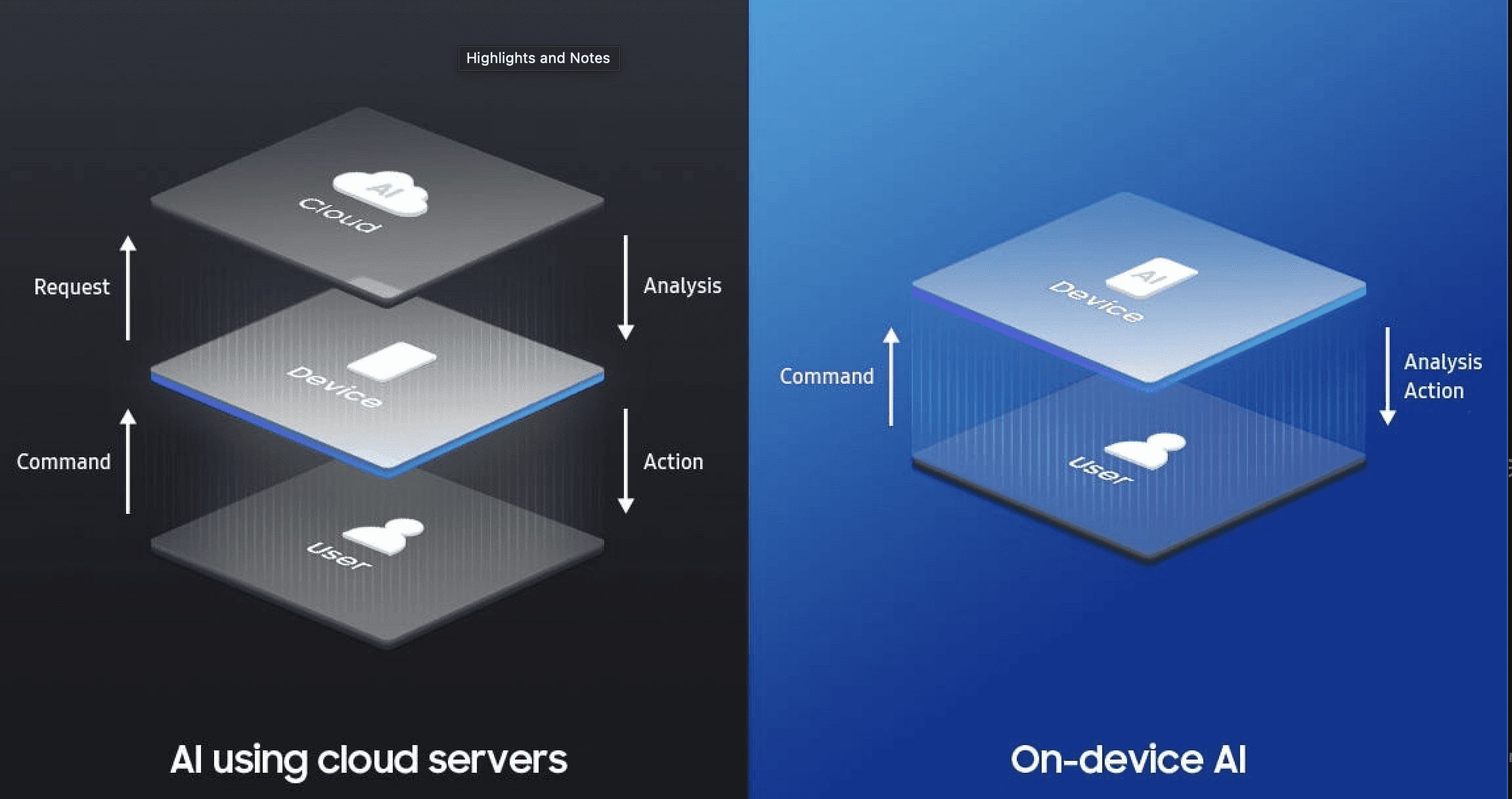
On-device AI does what it says on the label. Instead of outsourcing intelligence to a server, your phone, tablet, or smartwatch runs the model itself. Your data doesn’t leave your device. Your AI doesn’t wait on a signal.
And then there’s TinyML — an even more constrained form of this. It’s the art of getting machine learning models to run on hardware with almost no memory, no power, and no room for waste. It’s hard, but it’s starting to work.
This shift matters more than it seems.
Where You’ve Already Seen It
If you’ve used iOS 18, you’ve met Apple’s “Apple Intelligence.” It rewrites your texts, suggests edits, and even generates images — all while staying on-device where possible, using the Apple Neural Engine under the hood.
On Android, Google’s Gemini Nano brings AI features to Pixel phones — think smart replies, text summarization, and voice transcription, no internet needed.
And under it all? Hardware designed just for this purpose.
Qualcomm’s Snapdragon 8 Gen 3, Apple’s M3 chips, Google’s Tensor chips — they’re all built to run AI locally, efficiently, and with minimal impact on your battery life.
Why On-Device AI Wins
Privacy is the obvious one. No data leaves your phone unless it has to.
But there’s more:
Latency: Local models respond immediately. No network lag.
Energy efficiency: No back-and-forth to a server = battery savings.
Offline access: AI still works when you’re deep in a no-signal zone.
It also makes your phone feel smarter in subtle ways — faster autofocus, better voice typing, or automatic photo tagging that doesn’t need cloud processing.
The Hardware-Software Sync
None of this would be possible without tight integration between software and hardware.
Take Apple. Its Neural Engine is optimized to run models quickly and privately. Google’s Tensor chips are custom-designed to balance general processing with AI workloads. Qualcomm’s chips can even handle models with billions of parameters directly on the device.
This is what makes the experience seamless — the AI works not because of massive compute power, but because it’s running on a chip built specifically for the job.
The Catch
Of course, it’s not perfect.
Compressing large models like GPT-style transformers to fit on a smartphone is incredibly hard. Developers use techniques like quantization and distillation, but there’s always a trade-off between performance and size.
And local models, ironically, can be more vulnerable to tampering or reverse-engineering if not well protected.
Still, the trajectory is clear: the boundary between “device” and “intelligence” is vanishing.
What Comes Next?
TinyML and on-device AI are heading far beyond phones.
Think wearables that analyze stress in real time, drones that navigate without GPS, or home appliances that understand context and adapt. It’s not just about convenience. It’s about trust, speed, and independence. We’re moving into a future where your devices don’t just connect to intelligence — they are intelligent.
Final Thought
The beauty of on-device AI isn’t just that it works. It’s that it works quietly, without requiring you to trust a cloud, without draining your battery, and without needing perfect connectivity.
It’s AI that lives with you — in your phone, your watch, maybe your earbuds — running smarter than ever, and more privately than ever.
And that might be the most important shift AI has made in a long time.
Not long ago, AI meant the cloud. Today, it lives in your phone. Quietly. Locally. And it’s just getting started.
A couple of years back, using AI meant hitting a remote server, waiting a few seconds, and hoping your data was secure in some giant data center. But now, we’ve reached a point where your phone — without internet — can run intelligent models that feel almost magical.
This is what we’re calling on-device AI, and when it runs on ultra-low power chips or microcontrollers, it’s often grouped under TinyML.
What’s wild is, this isn’t some lab experiment. You’re already using it.
From Cloud-First to Local-First
On-device AI does what it says on the label. Instead of outsourcing intelligence to a server, your phone, tablet, or smartwatch runs the model itself. Your data doesn’t leave your device. Your AI doesn’t wait on a signal.
And then there’s TinyML — an even more constrained form of this. It’s the art of getting machine learning models to run on hardware with almost no memory, no power, and no room for waste. It’s hard, but it’s starting to work.
This shift matters more than it seems.
Where You’ve Already Seen It
If you’ve used iOS 18, you’ve met Apple’s “Apple Intelligence.” It rewrites your texts, suggests edits, and even generates images — all while staying on-device where possible, using the Apple Neural Engine under the hood.
On Android, Google’s Gemini Nano brings AI features to Pixel phones — think smart replies, text summarization, and voice transcription, no internet needed.
And under it all? Hardware designed just for this purpose.
Qualcomm’s Snapdragon 8 Gen 3, Apple’s M3 chips, Google’s Tensor chips — they’re all built to run AI locally, efficiently, and with minimal impact on your battery life.
Why On-Device AI Wins
Privacy is the obvious one. No data leaves your phone unless it has to.
But there’s more:
Latency: Local models respond immediately. No network lag.
Energy efficiency: No back-and-forth to a server = battery savings.
Offline access: AI still works when you’re deep in a no-signal zone.
It also makes your phone feel smarter in subtle ways — faster autofocus, better voice typing, or automatic photo tagging that doesn’t need cloud processing.
The Hardware-Software Sync
None of this would be possible without tight integration between software and hardware.
Take Apple. Its Neural Engine is optimized to run models quickly and privately. Google’s Tensor chips are custom-designed to balance general processing with AI workloads. Qualcomm’s chips can even handle models with billions of parameters directly on the device.
This is what makes the experience seamless — the AI works not because of massive compute power, but because it’s running on a chip built specifically for the job.
The Catch
Of course, it’s not perfect.
Compressing large models like GPT-style transformers to fit on a smartphone is incredibly hard. Developers use techniques like quantization and distillation, but there’s always a trade-off between performance and size.
And local models, ironically, can be more vulnerable to tampering or reverse-engineering if not well protected.
Still, the trajectory is clear: the boundary between “device” and “intelligence” is vanishing.
What Comes Next?
TinyML and on-device AI are heading far beyond phones.
Think wearables that analyze stress in real time, drones that navigate without GPS, or home appliances that understand context and adapt. It’s not just about convenience. It’s about trust, speed, and independence. We’re moving into a future where your devices don’t just connect to intelligence — they are intelligent.
Final Thought
The beauty of on-device AI isn’t just that it works. It’s that it works quietly, without requiring you to trust a cloud, without draining your battery, and without needing perfect connectivity.
It’s AI that lives with you — in your phone, your watch, maybe your earbuds — running smarter than ever, and more privately than ever.
And that might be the most important shift AI has made in a long time.
Not long ago, AI meant the cloud. Today, it lives in your phone. Quietly. Locally. And it’s just getting started.
A couple of years back, using AI meant hitting a remote server, waiting a few seconds, and hoping your data was secure in some giant data center. But now, we’ve reached a point where your phone — without internet — can run intelligent models that feel almost magical.
This is what we’re calling on-device AI, and when it runs on ultra-low power chips or microcontrollers, it’s often grouped under TinyML.
What’s wild is, this isn’t some lab experiment. You’re already using it.
From Cloud-First to Local-First
On-device AI does what it says on the label. Instead of outsourcing intelligence to a server, your phone, tablet, or smartwatch runs the model itself. Your data doesn’t leave your device. Your AI doesn’t wait on a signal.
And then there’s TinyML — an even more constrained form of this. It’s the art of getting machine learning models to run on hardware with almost no memory, no power, and no room for waste. It’s hard, but it’s starting to work.
This shift matters more than it seems.
Where You’ve Already Seen It
If you’ve used iOS 18, you’ve met Apple’s “Apple Intelligence.” It rewrites your texts, suggests edits, and even generates images — all while staying on-device where possible, using the Apple Neural Engine under the hood.
On Android, Google’s Gemini Nano brings AI features to Pixel phones — think smart replies, text summarization, and voice transcription, no internet needed.
And under it all? Hardware designed just for this purpose.
Qualcomm’s Snapdragon 8 Gen 3, Apple’s M3 chips, Google’s Tensor chips — they’re all built to run AI locally, efficiently, and with minimal impact on your battery life.
Why On-Device AI Wins
Privacy is the obvious one. No data leaves your phone unless it has to.
But there’s more:
Latency: Local models respond immediately. No network lag.
Energy efficiency: No back-and-forth to a server = battery savings.
Offline access: AI still works when you’re deep in a no-signal zone.
It also makes your phone feel smarter in subtle ways — faster autofocus, better voice typing, or automatic photo tagging that doesn’t need cloud processing.
The Hardware-Software Sync
None of this would be possible without tight integration between software and hardware.
Take Apple. Its Neural Engine is optimized to run models quickly and privately. Google’s Tensor chips are custom-designed to balance general processing with AI workloads. Qualcomm’s chips can even handle models with billions of parameters directly on the device.
This is what makes the experience seamless — the AI works not because of massive compute power, but because it’s running on a chip built specifically for the job.
The Catch
Of course, it’s not perfect.
Compressing large models like GPT-style transformers to fit on a smartphone is incredibly hard. Developers use techniques like quantization and distillation, but there’s always a trade-off between performance and size.
And local models, ironically, can be more vulnerable to tampering or reverse-engineering if not well protected.
Still, the trajectory is clear: the boundary between “device” and “intelligence” is vanishing.
What Comes Next?
TinyML and on-device AI are heading far beyond phones.
Think wearables that analyze stress in real time, drones that navigate without GPS, or home appliances that understand context and adapt. It’s not just about convenience. It’s about trust, speed, and independence. We’re moving into a future where your devices don’t just connect to intelligence — they are intelligent.
Final Thought
The beauty of on-device AI isn’t just that it works. It’s that it works quietly, without requiring you to trust a cloud, without draining your battery, and without needing perfect connectivity.
It’s AI that lives with you — in your phone, your watch, maybe your earbuds — running smarter than ever, and more privately than ever.
And that might be the most important shift AI has made in a long time.
Be the first to know about every new letter.
No spam, unsubscribe anytime.